
Thoughts on using, stowing and deploying towlines and on making your own boat mounted tow system.
Modified Deck Mounted Bag
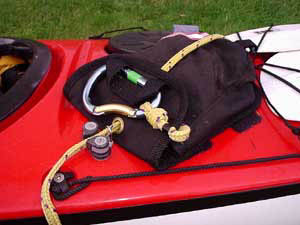
My modified Valley tow-line bag.
Go to |
||||
For reasons outlined earlier, I wanted a tow line which could be deployed with only “one action”, so I decided that some modifications were necessary to the system as originally designed:
- I wanted the bag to remain on deck so as to prevent any
possible snag risk as it came off.
- The tow-hook had to be much more readily released from some form of retaining system – just having it loose in the bag was an option, but I found that when the flap was opened it tended to fall out under its own weight which left me having to recover it before I could use it – not the best thing to have to do in big seas, even accepting that the float will prevent it sinking.
I made a suitable hole in the corner of the bag, using a 1/2 inch brass eyelet and a bit of webbing to provide reinforcement.
I also made a hole in the flap to allow the line to pass through the bag – again, a brass eyelet with reinforcement finished it off nicely and the line runs cleanly through on release, leaving the bag on the deck. The closed end already has a hole, which was originally where the line exited, that now has a short line secured inside with a small ball, and a small hook which clips to the boat.
This set up also means I can easily shorten the line if necessary just by pulling it through the bag and cleat, conditional of course on not using a knot in the line to prevent the daisy chain hook from falling off.
| |
|
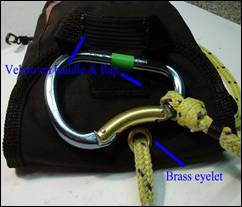
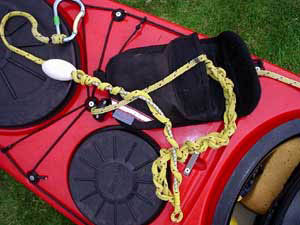
By sewing some Velcro to the grab handle and the
flap so that the tow-hook is secure under the loop which opens the
flap, I now have a system that holds the tow hook securely on the
flap but allows “one action” deployment as grabbing the hook and pulling
it toward me (a natural, logical action) now releases the hook, opens
the bag and deploys the line. |
 |
 |
 |
|
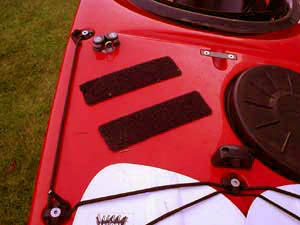
Two strips of self-adhesive Velcro on the deck secure the
modified Valley tow-line bag. Picture also shows the bulls eye and
deck cleat. Ideally, ensure you have one with a fairlead as shown. |
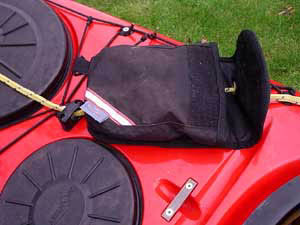
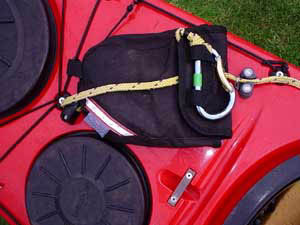
The line passes thro the bag, through an eyelet in the flap
and then through the cleat. |
The line is then taken over the bag and stuffed inside. |
 |
|
Once the line is stowed, the hook is secured under the grab handle - velcro has been sewn to the flap and the handle to hold it closed. Grabbing the hook and pulling releases it from the handle, opens the bag and allows the line to stream clear. Objective met! One action now deploys the line. |
|
Using the bag system rather than mounting the line down the side of the boat also allows a longer line – 15 to 20 meters seems to be a common suggestion and would certainly allow much more flexibility in big swells as the 7 meter line I originally used really only gave about 5 meters separation between the boats and that probably isn’t enough.
As mentioned earlier, that line has now been replaced with 20 meters of floating line and that seems to give me more options. It's daisy chained in the bag with a clove-hitch used to secure the end of the chain in preference to a clip. Chained, it's about 10 meters, and that's more than adequate for most tows. I've also dispensed with the shock absorber as the line itself is inherently stretchy and certainly has enough give in it to compensate for shock loading.
Shortening in use is easy, I release the clove hitch and let the chain clear itself - then it's just pulled through the cam cleat - adding length to a short line isn’t an option so my view is that it's better to have a longer line than a short one!
NOTE: The current (2013) Valley Deck Mounted Tow System will require a little modification to mirror my set up - as supplied, the bag is intended to mount with the flap facing forwards. There is a short tail of rope exiting the bag at the closed end which is fed through the bulls-eye and then the towing cleat. The line is secured into the bag with a plastic ball and the knot which attaches the bungee, which is inside the bag and then attached to the line.
The intention is that when the line is deployed, the bag will rip off the deck as the line tensions, but is of course secure as the line is passed through it and the bag can't fall off thanks to the knot and plastic ball securing it. While I see the logic of that, my solution when fitting this to a friend's boat was to dispense with the plastic ball and relocate the bungee to the hook end. I also left a length of clean line between the hook and the float before attaching the bungee, so as to allow the hook to be attached through the deck lines as suggested in the recent Gordon Brown safety videos. As supplied, the float is right up against the tow hook.
Finally, their set-up initially positions the end of the daisy chain by the hook - the logic being that you'll decide whether you want a short or a long tow at outset, depending on conditions. However, if you start with a short tow, you'll have to get right back to the hook to release the chain. My personal preference is to have the end of the chain at my end. There are no right / wrong solutions - just different approaches.
Go to |
||||
~ The UK Rivers Guidebook and UK Sea Kayak Guidebook Websites, the home of UK paddling on the Net ~
COMMUNITY TRIPS ALMANAC CONTRIBUTE BOOKS RIVERS