|
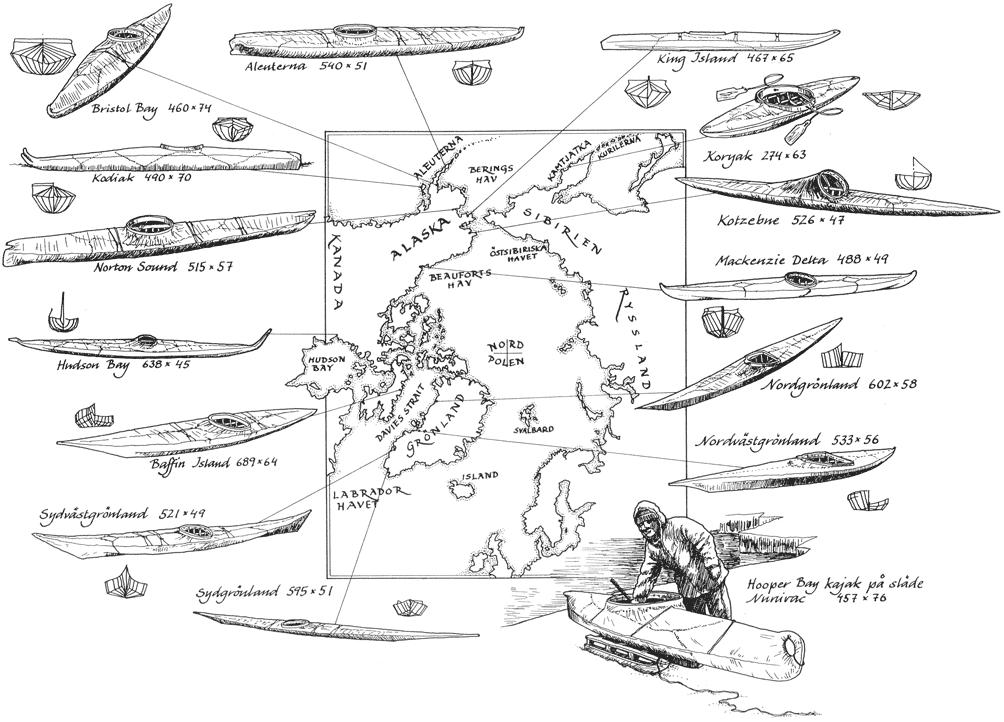
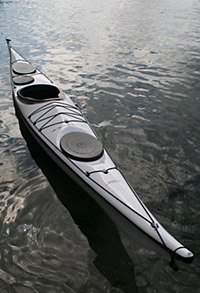
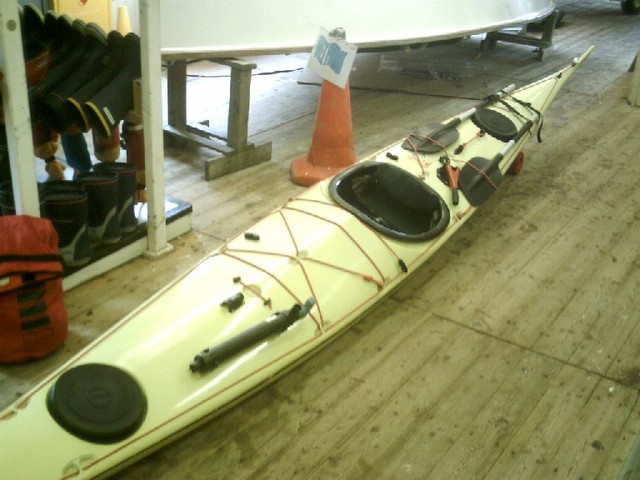
This fascinating diagram (found on Facebook -
original source unknown, but may be from http://www.adventurerace.lv)
illustrates the wide variety of kayak types used by indigenous
peoples. Some, it could be argued, are prettier than others. Further
details of lots of replicas of traditional kayaks are on traditionalkayaks.com
Blackford's craft was used as the plug for a fiberglass
mould and eventually found its way to Frank Goodman of Valley
Canoe Products who went into production in 1972 under the name
Anas
Acuta, a boat still made today. In doing so he introduced
the company to the world of sea kayaking while producing the first
commercially produced fiberglass seakayak.
In July 2015, Duncan Winning sent me a mail from
Robert Todd in which he writes - "I have just realised
that my first Nordakpp kayak (purchased May/June 1975) was in
use on the West Coast of Scotland before the actual Nordkapp expedition
took place (starting in July 1975). I paddled this Nordkapp on
a Northern Coaching Panel trip to the Gulf of Corryvreckan (led
by Lofty Wright) at the end of June 1975.
In early 1975 I read about the modifications
required to the Anas Acuta (after their training trip round Skye
in 1974). They would call the new kayak the ‘Nordkapp’. Valley
Canoe Product’s catalogue didn’t mention hatches and bulkheads
for the Nordakpp but I phoned VCP (think it was Frank Goodman
I spoke with) and asked for a price for a Nordkapp with Hatches
and Bulkheads. I took delivery of an all red Nordkapp in early
June 1975. (I already had a lightweight Anas Acuta, which might
still be around in Largs ???.) I still have this early Nordkapp
but it usually used now by my wife. It came with aluminium T-Bar
hatches but these eventually had to be replaced. Other than that
it is the original Nordkapp. I bought another Nordkapp (same specification,
but with plactic hatches) in 1980 which I still use to this day!"
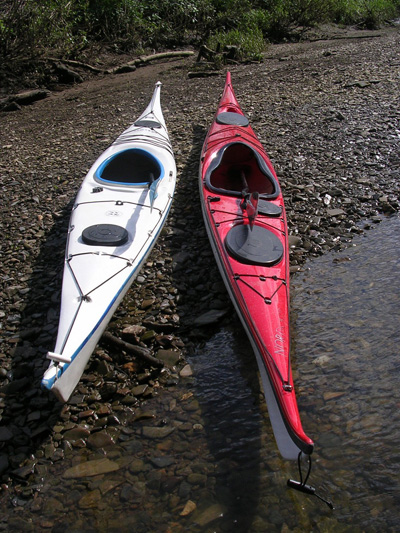
This
picture of an early Anas Acuta beside a modern Wilderness
System's Tempest clearly shows the low profile in comparison to
the mass of the newer craft. One wonders which needs a rudder!
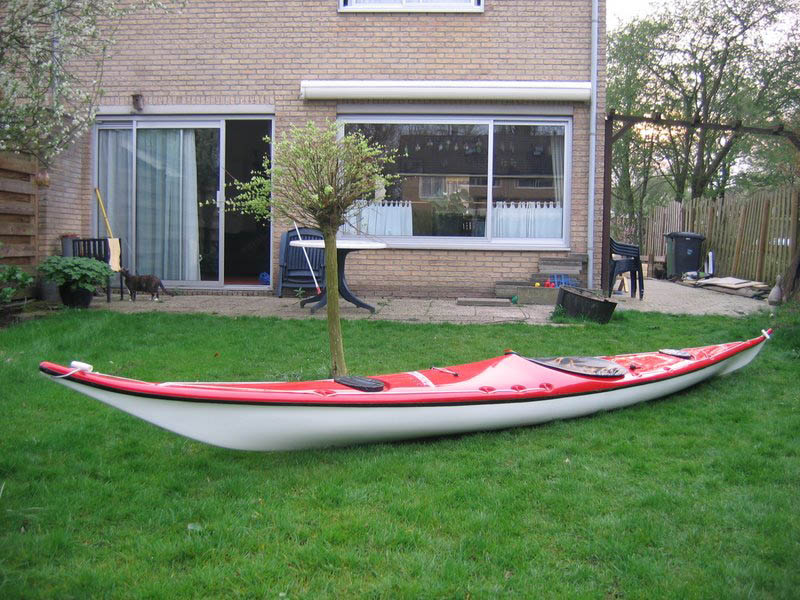
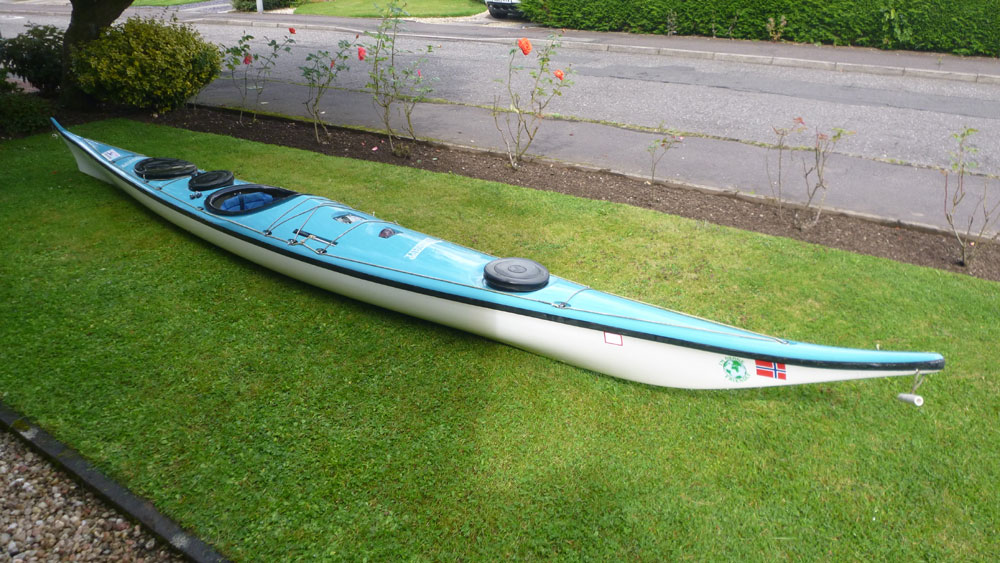
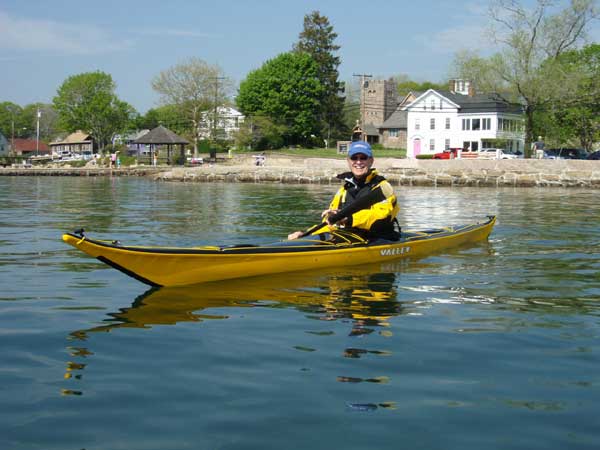
Ido van der Meer's
picture of his Anas Acuta illustrates the classic lines of
these boats, as does this shot of one taken on Loch Teacuis in
May 2013.
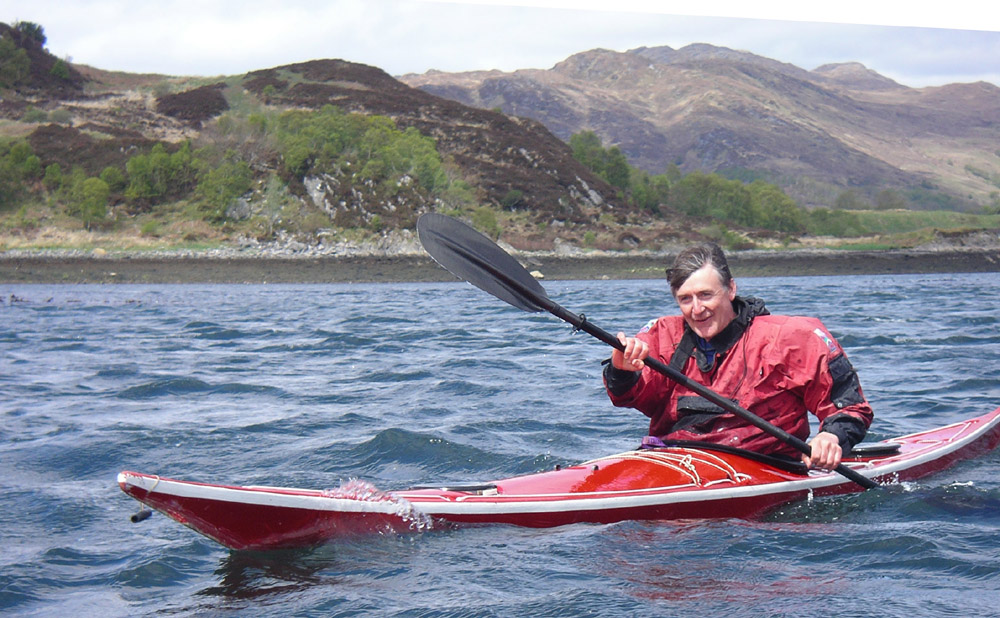
John on Loch Teacuis, May 2013, in an early Anas
Acuta. It just looks "right"! Pic: Mike Buckley.
In September 2009, Duncan very kindly provided UKSKGB
with the text
of his history of the Ken Taylor boat, and also included the
"family tree" and a copy of the line drawing of the
original boat, together with a further historically important
work showing how the Taylor boat influenced sea kayak design in
the UK. There are also excellent images of the boat on Loch Lomond
in the article.
Thanks to the Winston
Churchill Memorial Trust, which provides some 100 traveling
fellowships annually, Duncan was fortunate to be awarded one of
only two fellowships in a canoeing-related field for 2004 and
in July of 2004 he set off to Greenland on a four-week project
titled “The
Inuit Origins of Modern Recreational Sea Kayaks.” Sea Kayaker
magazine details that project.
Further reading on the Greenland Kayak, notably
the differences between East and West Greenland types can be found
in the article by Sandy Noyes, page 54. in the
Summer 2011 issue of Masik. It also contains an article on
the various other types of kayaks used by native peoples, itself
interesting in that the rationale between hunting craft and boats
designed for travel is clearly evident. This article
by Jeff Fabiszewski also outlines the differences between
the East and West Greenland types. The
Summer 2013 issue of Masik contains a fascinating and in-depth
article on "Deconstructing Greenland Kayaks" which describes
the background to how these boats were built.
From the April/May
2008 issue of KASC, in an article on Giona Watkins (P.18)
there is this interesting note - "The physical shape of the
native kayak hunter east or west coast of Greenland is much the
same while the design of the kayaks they used was dictated by
conditions which are very different. The West Greenland kayak,
exemplified by the Anas Acuta and Nordkapp designs, was used on
open waters with high amplitude wave forms while the East Greenland
kayak was used on water where the wave forms, damped by floating
ice, had small amplitude. The West Greenland kayak is more sea
kindly while the East Greenland kayak is swifter and easy to roll
with or without a paddle".
In 1975 Colin
Mortlock, a noted British mountaineer and exponent of outdoor
education, proposed an expedition along the Arctic fiords of Norway
to Nordkapp, the northern-most cape of Europe. Mortlock and his
team had paddled the Anas Acuta kayaks around the Isle of Skye
but believed that a new sort of boat would be needed, one that
could take huge quantities of supplies without losing too much
maneuverability and seaworthiness. Frank Goodman of Valley Canoe
Products created the Nordkapp to fulfill that need, using the
Anas as the inspiration.
The design principles adopted in this kayak i.e.
moderately V’d keel, softer chines and the distinct Greenland
side profile (although with increased freeboard to accommodate
the increased loadings - the boat was designed to carry a 90 kg
load) become so widespread in other kayaks that Valley
have said that these characteristics became known worldwide as
“The British Style”.
In 2012 I received some pictures of one of the boats
used on the 1975 Expedition.
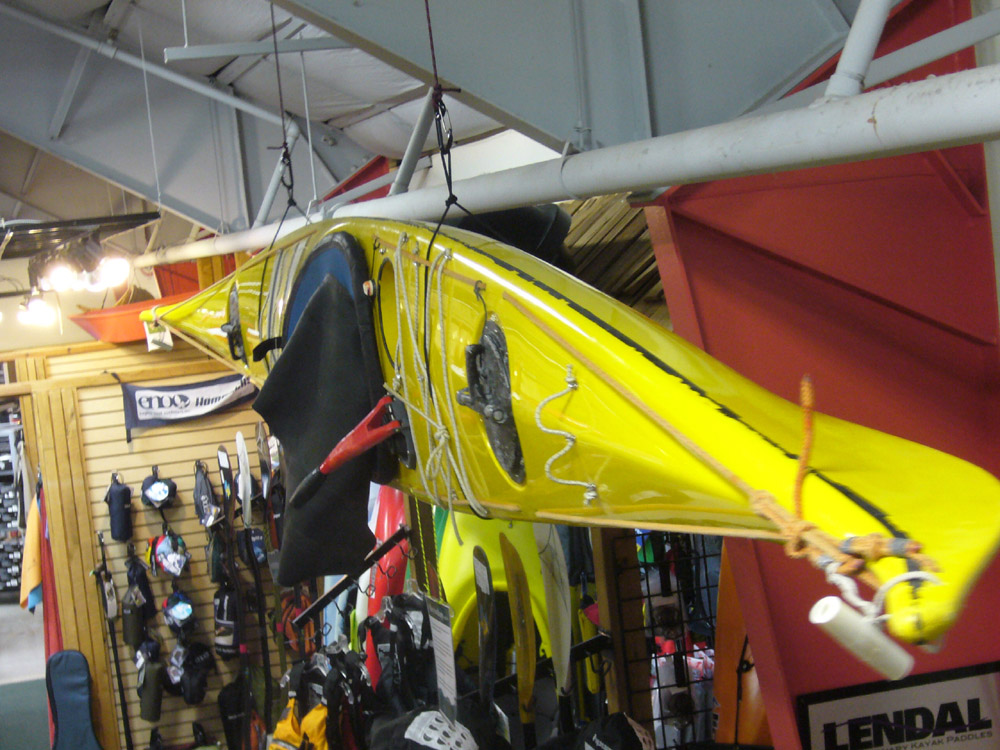
There are a number of other pictures of that boat,
and the full
picture set is here.
Thanks are due to Darren Bush of Rutabaga
in Madison, Wisconsin for the pictures, and to Brian Day of Pyranha
US Sales and Marketing for the initial lead.
Brian told me this in an email - "Back
in the late 90’s I worked there and we found the boat sitting
on a rack over at Nigel
Dennis’ place. We arranged for it to be loaded into a container
and shipped over to become part of the small canoe and kayak collection
that we had at the shop".
Paul
Caffyn's article "The
Long Journey Home for a Greenland Kayak", the story of
his 1999 trip to West Greenland, also details some interesting
history of the boat. Paul has used Nordkapps for some significant
trips, In 1978, he circumnavigated the South Island of New Zealand
solo, a 2500 km (1,550-mile) journey that he completed in 75 days.
In 1979, he circumnavigated the North Island, 2700 km (1,700 miles)
in 86 days - and
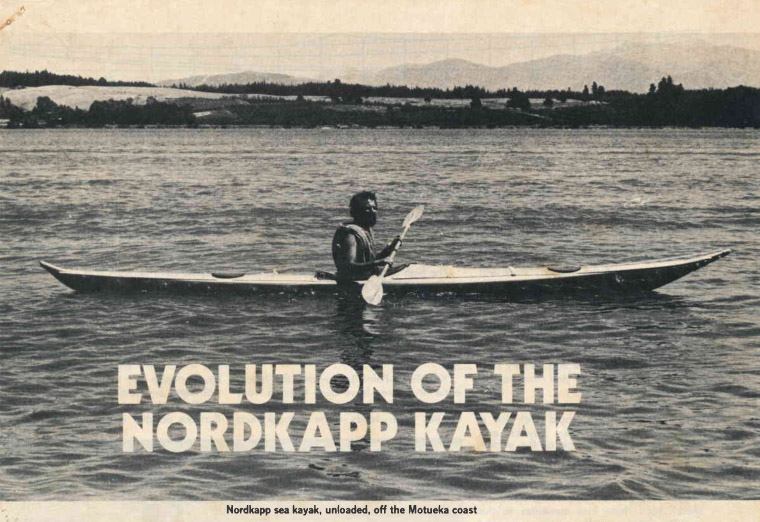
there are many others. In 2012 he very kindly sent me this
fascinating article written by Graham Egarr in 1979, detailing
the Evolution
of the Nordkapp Kayak.
The National Maritime Museum in Cornwall noted
that "the boats used on the Nordkapp expedition pioneered
a number of features that, although commonplace now, were unique
to the Nordkapp design including:
• The provision of watertight hatches on fore
and aft decks, together with internal watertight compartments
sealed from the cockpit area
• A hand operated bilge pump, installed on
the rear deck, to allow the cockpit to be pumped dry in the
event of a capsize
• Deck fittings moulded into the deck of the
kayak, allowing deck lines and elastic fastenings to be neatly
fitted to the boat
• A moderately veed keel and the fitting of
a removable skeg to provide greater directional stability. After
the Nordkapp expedition a skeg was permanently moulded to the
hull, this being intended to solve the boat's tendancy to weathercock".
That worked, but produced a boat which had to be
put right over on edge to get it to turn as it then tracked like
a train. In really strong winds, it had a tendency to leecock
and this is a consistent comment from many paddlers, of which
more will be found later in the article. It's not known exactly
when the HM hull was first produced, but p13 of the 1977 Cape
Horn Expedition Report shows a line drawing of an HM hull.
I heard from Nigel Matthews in 2012 and he mentioned
that "Team members of the Horn Expedition, myself, Frank
Goodman, Barry Smith and Jim Hargreaves are still around and Frank
celebrated his 80th birthday some time ago. Barry is living in
Edinburgh and still very much out of doors, Jim is living in Canada
and still paddling the last we heard. I got spoiled by paddling
in warm water off Bermuda so my outdoors is spending winters in
the Alps skiing."
Writing in UKSKGB in 2005, Jim Wallis provided this
succinct summary of Nordkapp history - "The original
Nordkapp was developed by Frank Goodman for the Nordkapp Expedition
way back in 1975, making the basic design 30 years old this year,
although it took inspiration from centuries of Inuit kayak development.
The original boat proved seaworthy, fast and able to carry large
amounts of kit, but weathercocked more than was comfortable. To
solve this only problem a small fixed skeg was added to the after
part of the hull. These boats were designated as HM's.
The result is a boat that tracks very well,
and is still fast and can carry a lot, the only issue then being
that it wasn't very maneuverable. The original Nordkapp then became
HS. More recently further development was undertaken to increase
the waterline breadth of the standard hull for more initial stability
and use the now generally accepted lifting skeg to counter weathercocking
when needed - this boat is called the Nordkapp Jubilee".
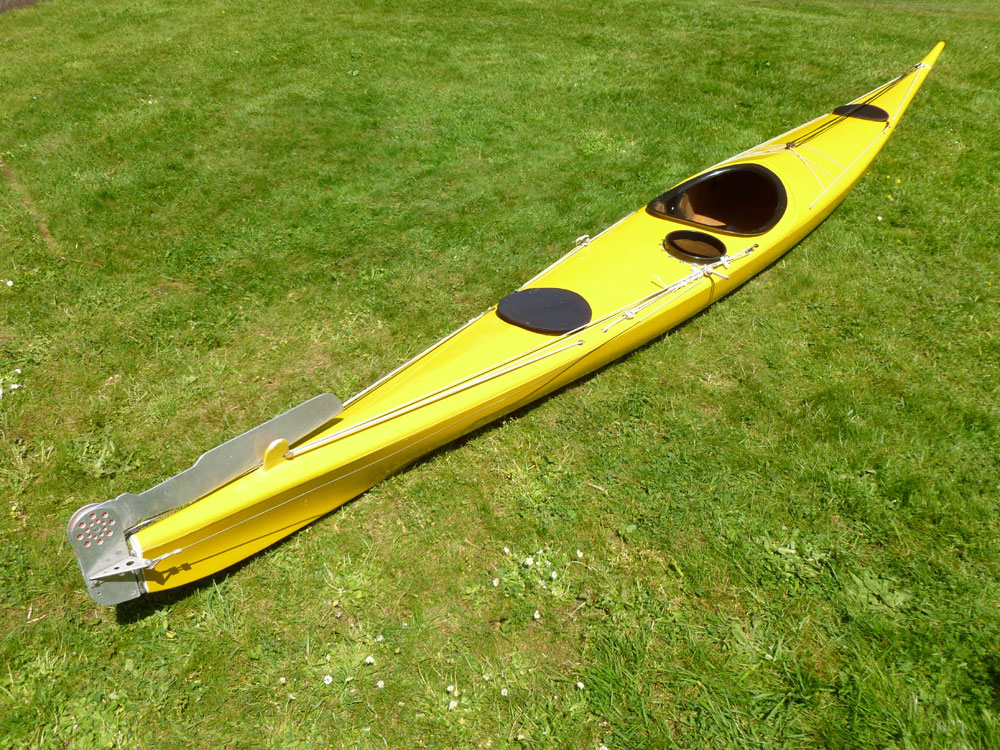
According to the Nordkapp
page of their 1985 brochure, Valley offered 12 variants of
the Nordkapp in those early days. (Thanks to Arnold Kuiter for
the .pf). You could have a basic boat with no hatches and the
original hull design (an SS - Standard deck / Standard hull) or
a pair of hatches and either the standard or modified hulls (HS
or HM - Hatches / Standard or Modified hull). If you wanted a
"large, racing style cockpit with a sliding seat", that
too could be yours with the designation L. There was even an R
variant, that having a hull fitted with an inbuilt understern
rudder.
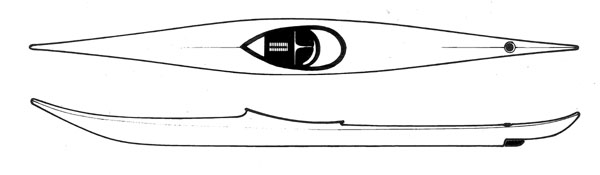
Nordkapp LR - "Long cockpit with sliding
(racing) seat - built in understern rudder"

This one was advertised on eBay in Jan 2013 -
described as an LS, we may surmise that it has a Long cockpit,
Standard hull.
The raised cockpit coaming suggests it may originally have been
the racing variant, which came with a sliding seat - this one
seems to have a fixed backrest, so may well also have a fixed
seat.
Note the complete lack of decklines and hatches! It also looks
like it doesn't have the understern rudder.
By 1988,
the Valley brochure (now in colour) mentions two cockpit sizes
- and notes that "Not every one of the twenty-seven combinations
is available. But most are. Check out just what we can do; then
you can have the boat of your choice, especially tailored to your
requirements".
If you enjoy such things, there are many hours of
happy banter to be had debating the actual designations of the
letter H on an original Nordkapp and it had been widely accepted
that the H actually referred to "Hull". I note that
even Peter Orton who, together with Jason Buxton, bought Valley
in about 2005 (can anyone confirm the date?) having previously
been with P&H, has referred to the HS as "standard hull".
The very early HS's may not have been fitted with
a drop down skeg, but it certainly made an appearance eventually.
Although these were usually operated by a cord and bungee system
in early boats from many manufacturers, Ido van der Meer from
the Netherlands has what may be a very early example, which uses
a rectangular
rudder blade. He reports that the control was located behind
the cockpit. A retractable skeg is mentioned as an option in the
1988 catalogue accessories list - illustrated
in detail in this diagram, it's wire operated, and seems similar
to the one on Ido's boat.
"Haris", writing in his excellent blog,
Paddle'N'Hull in August 2011 provides an excellent and succinct
summary of the details of his 1987 Nordkapp HS and compares
it to a 2000 American model with "Jubilee" on the deck
and "H2O" on the manufactures sticker. He also provides
a summary of the distinctions between his older model and the
modern "Classic".
He too notes that the skeg control on the earlier
boat was originally located aft of the cockpit, a position he
found somewhat difficult to use, resulting in a capsize! He also
comments that the pump was interesting to use, not least because
he once found himself pinned to the back deck as the handle snagged
on his BA straps while attempting a lay-back roll.
As the 1985 catalogue shows, hatches were an option
and the earliest boats usually had Henderson
metal hatches secured by a cammed lever. Colin Cooper comments
that the hatch cover seal was a very flimsy o-ring and the hatches
themselves corroded badly in the salt water despite being painted
with some form of black plastic paint. He eventually switched
to neoprene VCP hatches which came with a metal tensioning band
to help secure them, something no longer needed thanks to improvements
in design and materials and VCP hatches are now made of some form
of rubber.
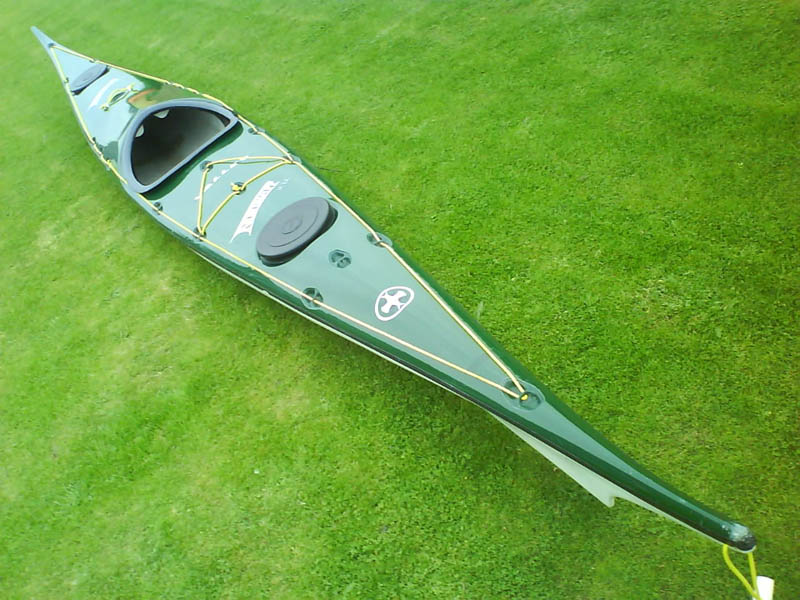
"Aeden's" superb Nordkapp HM - believed
to be somewhere around 1985 or 1988 - although a discusion on
Facebook in February 2015 raises the question as to when the moulded
deck fittings clearly shown were replaced by the modern bolted
in RDFs. Howard Jeffs commented in that discussion that the deck
fittings were just GRP on the very early boats, however they were
prone to break. Because of this, they then put a small aluminium
bar inside the fitting when gelling up. Gordon Brown commented
on the same post that the the HM which he bought in 1980 has the
more modern bolt-in RDF.
Note the knee braces (fitted as standard) in the
ocean cockpit, and the relatively raised rear deck typical of
later models. Pic: "aeden"
A comment from Gordon Brown on Facebook in February
2015 notes that "the cammed lever hatches seem to have
been in use until late 1970's, Henderson screw ones from 1980
to 1983, then VCP rubber as we still have". Developed
in the 1980's and ground breaking in their own way, Valley
hatches were a very significant improvement on the standards
of the time and the concept has been followed by others like Kajak
Sport. Even today some manufacturers still haven't caught
up. There is a suggestion that Valley originally designed the
hatch size to take a small Trangia
- but this could just be urban myth as I suspect they were initially
just using that which was readily available.
The Henderson
screw on covers are reported as being prone to jamming owing
to sand in the threads, or pressure differential in the hatch.
The centre section can drop out and get lost so these aren't ideal
for a kayak. That said, Chris Pendlebury mailed me in January
2014 and comments that "Valley themselves fitted Henderson
plastic screw on hatches. I have a 1978 HS and a 1982 HM, both
fitted with plastic Henderson screw ons when bought new from Valley.
They have never given any trouble, though I do wonder about the
state of the plastic after 30+ years."
Quite a few had the "Chimp"
rear-deck mounted pump, these having been used on the Nordkapp
expedition. Very difficult to use as the pumping action is offset
to one side and therefore rather wobble inducing. It seems that
the intention was for these to have been used when rafted, not
on one's own. Many have been removed and the resultant hole converted
to a day
hatch. Often done by using a 15 cm dinghy buoyancy tank inspection
hatch and glassing a new bulkhead in behind the seat, if the job
has been well done, it can be an elegant solution. Kajak Sport
make a variety of
different size hatches, so these too could offer an alternative.
In an era when boat design was really still in its
infancy, Valley were producing innovations such as recessed deck
fittings. On the early boats these were formed with a bar
moulded into the recess, as illustrated on "Aeden's"
HM. Later boats used the now commonplace bolt-in
recessed deck fitting.
A version
from the Southern Hemisphere was on the market too until
recently - built by Grahame Sisson of Sisson Kayaks, it is clearly
a Nordkapp descendant and it's interesting to see how the designs
have evolved over time and geographic distance with rudders clearly
being an accepted part of paddling culture "down under"
(and indeed in the US as well) whereas UK and European paddlers
generally prefer non-ruddered boats. Graeme also built a variant
known as the Arctic
Raider which his website describes as being "a more
stable, user friendly boat that offered our customers all of the
advantages of the Nordkapp".
Paul Caffyn mailed me this in December 2012 - "Interesting
thread here in NZ with the NK design. Grahame Sisson imported
a two piece HS mould in 1977, the boats he built through to the
early 90s were all HS hull models. In 1985, we built a 30 pound
JapKapp, and in my desire to minimize cockpit volume, Grahame
built a full seat/ bulkhead, which allowed a third compartment
deck accessible from the cockpit. From then on, all Graham's boats
had that middle / seat bulkhead.
Grahame was asked to make a boat for a bloke
with big legs, and made a raised foredeck model - still with the
HS hull. But in 1996, Grahame's Nelson factory burnt down, losing
everything, bar for a trailer load of kayaks he was taking on
a selling tour around the North Island.The only NK on the trailer
was a high foredeck one - he built a mould off this, and it became
the production boat in NZ until he retired earlier this year."
A look at the website in Jan 2013 finds this - "On
Monday the 3rd October 2011 we shipped out the last boats - a
Nucleus 60, Arctic Raider - and a Nordkapp". Rather fitting.
| |
|
|
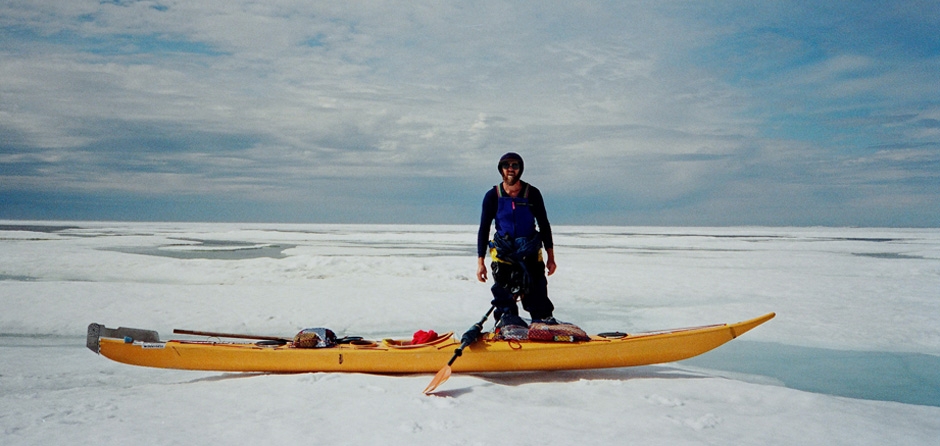
Paul Caffyn, Alaska 91 - Sisson's Nordkapp
- "June 1991, on the far northern coast of Alaska,
when I was waiting for the summer breakup of the polar ice
sheet, to continue my solo paddle around the coastline of
Alaska from BC in Canada to Inuvik in the NW Territories.
The black vertical streak, visible on the hull, aft of the
cockpit, is the disgusting residue or mousse from the Exxon
Valdez oil spill in Prince William Sound.
The boat is a NZ Grahame Sisson's built Nordkapp,
with my overstern rudder design and Grahame's cunning
middle or third bulkhead forming the seat".
Pic: Paul Caffyn.
|
|
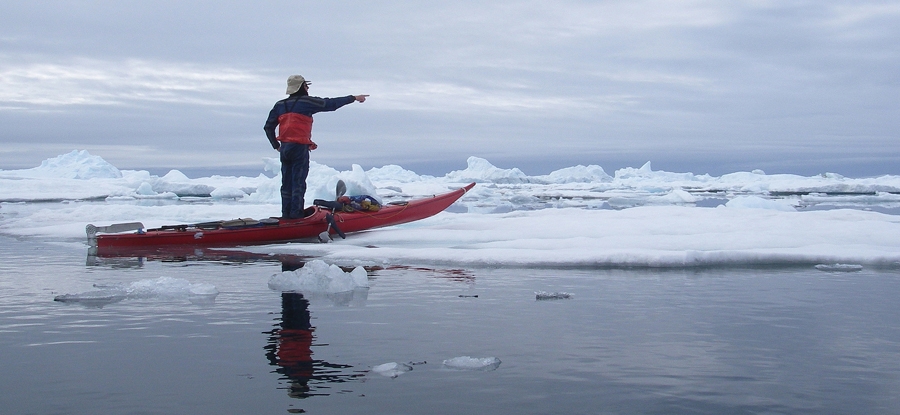
Paul Caffyn on floe, Ikertivaq - Sisson's
Nordkapp - 2008, "East Greenland, during a long
crossing of Ikertivaq. Shows the benefit of the NK's upswept
bow, by being able to paddle at speed onto ice floes. Very
handy for searching for leads through
the ice pack." Pic: Conrad Edwards. |
|
|
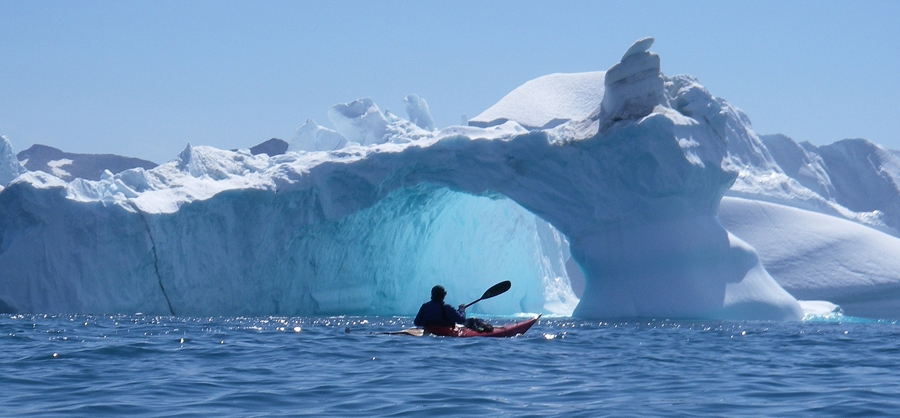
Paul Caffyn, with a "tunnel berg" - Sisson's
Nordkapp, paddling down the south-east coast of Greenland,
2008. Pic: Conrad Edwards
More pictures and details of this trip are to be found
in this PDF
of the August / September 2008 issue of KASK - "It
has photos from a paddle
down the south-east coast of Greenland from Angmagssalik
to Narsaq. A retrace of the Gino Watkin's open boat journey
of late 1931.
The boats were two piece kevlar boats, a must for flying
in to Kulusuk". Thanks to Paul for sending me
this.
|
However - this comment from from EK Sydney, from
Sydney, Aus, is quite telling - "I always think one of
the supreme ironies of Australian & NZ paddling and our (slowly
crumbling) culture of rudder-based sea kayak designs, is that
it sprang from the original HM Nordkapp, which was a tricky proposition
for paddlers like Paul Caffyn in following seas. Brian Towell
has a classic line in an ad on the QSKC website, trying to sell
his antique Nordkapp HM - "Paddles like an absolute bastard,
It's tippy, slow, won't turn, and you can't get in or out of it
- actually I quite like it and I wouldn't mind if it didn't sell."
When I was in Tassie in February I met Tony Gaiswinkler, who told
the story outlined above of how Caffyn sent an SOS for a 'Tasmanian
rudder', which Tony had a major hand in designing, after having
a bugger of a time controlling his Nordkapp on the journey from
Queenscliff to Brisbane. The HM had the 'skeg' which was just
an extended keel line, as opposed to the modern retractable version.
They sent him one up which was fitted (not too
sure if it was the original or a 'modification' of Tony's design),
and the journey continued with much more ease for Caffyn with
rudder fitted. This spawned several designs in Australia &
NZ which were essentially Nordkapps with the stern sewn off &
a rudder fitted, and our culture of boat design has evolved that
way ever since. The rudder design also reportedly found it's way
to Valley and became the C-Trim rudder - it seems to be a bit
of sore point in Tassie!"
Sean Morley posted
an article by Paul on his website - it makes interesting reading
in the the HS/HM/Rudder debate, notably in the context of the
distances covered after the boat was modified. An almost 30% improvement
in mileage makes a convincing argument!
Cockpit sizes have varied as well, with the standard
"Ocean Cockpit" being 20 x 15 ins and what has been
described as a "Slalom type cockpit" measuring 27 or
28 x 15 ins. Designated by a "C" suffix, it was mentioned
in a 1998 article on choosing a sea kayak by Atlantic Kayak Tours
in the US, but as of 16 Dec 2013 the article can't be found. One
is illustrated in this picture
on Paddling.net where reference is made to it being an HMC designation
- "The HMC on the foredeck indicates it has Hatches, Modified
hull (hard stern), and slalom Cockpit".
Determining the age of older Nordkapps is actually
quite hard - there is usually a "makers certificate"
glassed into the cockpit and it had been suggested that the first
two numbers represent the build date. However, it is more likely
that the last two are. Certainly, "aeden's" boat has
the serial number 7947/1/??/3 (the "??" being
illegible) and turns out to probably be 1985 to 1988. This also
was the case on the Aleut Sea II's I've had. But Valley may have
used a variety of serial number systems over the years. If they
have time, Valley have been known to help track down when a particular
boat was built and are generally responsive to a phone call.
The "modern" Nordkapps.
Towards the end of the 1990's, Valley produced the
Nordkapp Jubilee, to recognise 25 years of Nordkapp production.
It is debatable whether there is really much in common between
it and the original other than a shared name. The Jubilee is rather
larger than the original version, has a cable operated skeg rather
than the large fixed skeg of the old HM, a keyhole cockpit, an
oval stern hatch, a round day hatch and a large round front hatch.
The moulded recess for a Silva
70 is positioned for'ard of the front hatch on these boats,
and a range of options including keel strips, a choice of lay
up (diolene, kevlar etc) and Compac
50 deck mounted pumps were offered as well as the Henderson
foot pumps. You could also get a multi-part
version of the boat to ease storage and transport.
In 2003, Dave Felton of Knoydart, who had been heavily
involved with Valley, told me that in line with general product
development, Valley decided to fit an oval cover to the front
hatch on the Jubilee. As US dealers had existing stock with the
round front hatch they decided to "re-name" the boat
for the US market. It became Nordkapp H2O, which denotes Nordkapp
'hatch 2 x oval'. Valley introduced a vacuum
infusion molding process at about the same time.
At the same time they fined down the nose, lowered
the front of the cockpit area and reduced the rocker at the stern
slightly. The stern shape appears to be slightly different as
well. When the Jubilee was designed, it started with adding about
2 inches of rocker to just the stern section of the original.
Then some material was added just behind the seat area, to help
with handling and with stability. The oval hatch model (H2O in
the US) had the nose changed slightly too (a little less bulbous
than the Jubilee, but not quite as sleek as the original).
The older Nordkapp has the least rocker, then the
oval hatch model (H2O in the US), and then the Jubilee. Overall
the latest oval hatch version has about 1 inch less rocker in
the stern than the Jubilee. The Jubilee has about 2 inches in
the stern section.
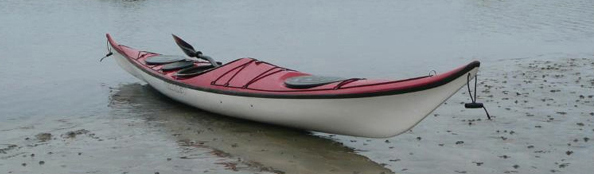
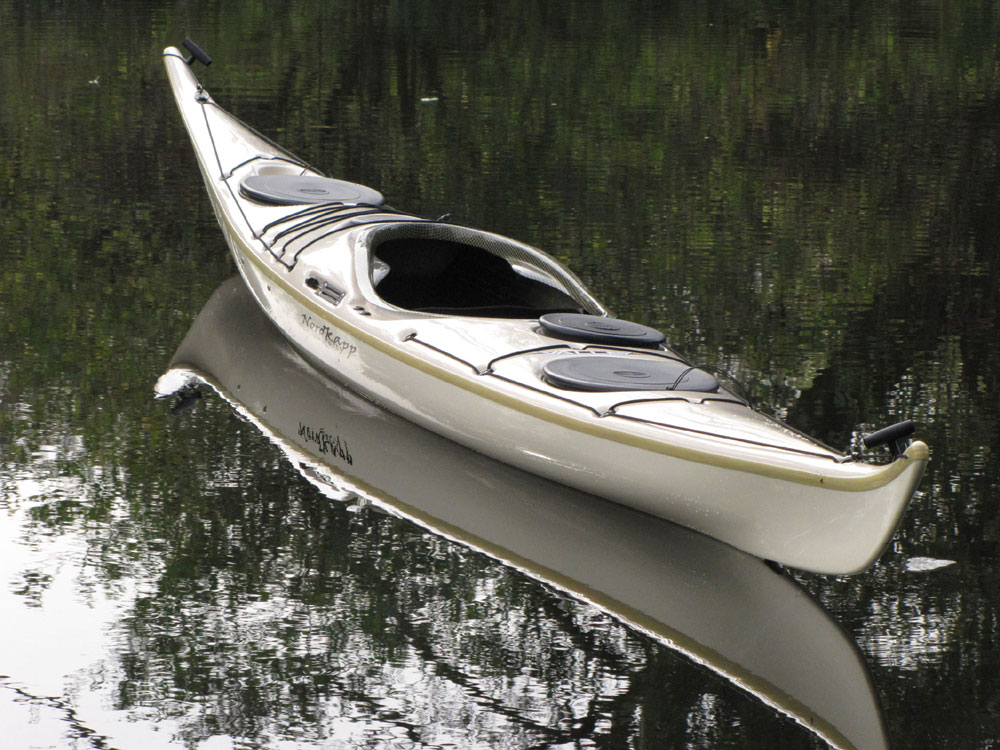
2006 Nordkapp. Pic: Tiff
The UK market never used the H2O name, and it appears
only to have been used in the US. This is probably due to the
US dealers holding stock as mentioned earlier, whereas the UK
market is generally "built to order". Tim Pickering
compared the original "round front hatch" N/kapp Jubilee
to the later "oval front hatch" version in a post in
2005 as follows - "I am paddling an H2O and I put it
next to a Jubilee and it is fatter, that is to say it has more
volume round the a*** and more of a u shape. We suspected this
was for the American market to make the boat more forgiving".
Tim lives in the Hebrides so clearly American nomenclature
has worked it's way (erroneously) into UK paddling circles - probably
thanks to internet forums.
It's important to appreciate that the US market
received a slightly different product offering from the UK / rest
of the world. The 2005
Valley / GRO brochure shows a boat called the Nordkapp Jubilee
M which has the HM hull shape. The brochure also shows a subtly
different boat called the Nordkapp H20. This was probably due
to Stan Chladek, the then owner of Great River Outfitters in Detroit,
Michigan, being a big fan of the HM Nordkapp.
Peter Orton, who had bought Valley by then, having
been at P&H before that, commented on a post on Paddling.net
that "because Stan was importing them (the HM Nordkapp)
to the US and championing them this was the one many paddlers
tried and subsequently got. Hence in the US the Nordkapps reputation
for tracking like a train and needing to be cranked right over
to turn. In reality Valley (in the rest of the world) has always
sold far more Nordkapps with the standard hull (the old HS) and
this is why the current version features this standard stern profile."
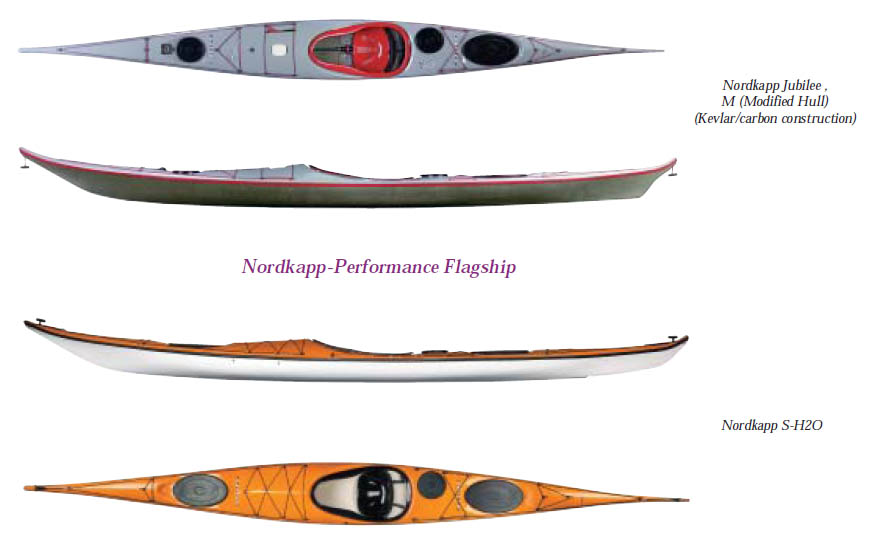
US spec "Nordkapp Jubilee M" with the
HM hull shape, and the US "H20" - from the 2005
Valley / Great River Outfitters brochure
I recall looking at a Nordkapp with the new oval
front hatch in Knoydart's shop in about 2004 and it certainly
carried the familiar Nordkapp decal on the foredeck, with no mention
of H2O on the boat. As far as the UK market was concerned, this
was just a product update to the Nordkapp Jubilee. The Jubilee
name seems to have been quietly dropped around about 2008 and
certainly wasn't being used when this article was originally written.
The H20 name also seems to have gone.
The LV version of the Nordkapp was developed in
2006 to provide a slightly smaller version, either for the smaller
paddler, or as a more playful day boat. Douglas
Wilcox reviewed it on his blog and was of the view that compared
with the Nordkapp Jubilee, it was a completely new shape. The
only dimension it shares with its namesake is overall width and
it has much finer bow and stern sections.

Douglas Wilcox's daughter, Jennifer, in a Nordkapp
LV on Loch Nevis in 2006. Pic: Douglas Wilcox
2006 also saw Valley introducing the Enthusiast
(or roto-moulded plastic) version - writing on Paddling.net, Peter
Orton commented "Originally the poly version was going
to be sized as per the full size composite version. However the
LV version has been such a hit we have decided to size the poly
half way between the standard and LV versions. So length is 17’9”
deck height ½” lower than the full size version width the
same as both versions of the composite". When Valley
launched their revised website in Jan 2010, this boat is referred
to as the RM (although they also reference it as the PE).
It would be natural for Valley to have totally ceased
production of the "original" Nordkapps when the Jublilee
was launched, but in or about 2007 they started producing a slightly
updated version of the "original" design which they
call the "Classic". This has the same hull shape as
the early Nordkapp, but uses the up to date deck layout of three
hatches. Available either as HS or HM, it was built with an ocean
cockpit. As of Jan 2013, when I viewed the Valley website during
an update of this article, it seems to have been dropped from
the range.
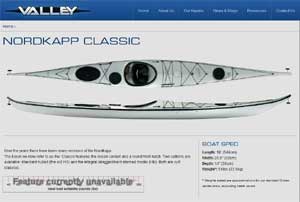
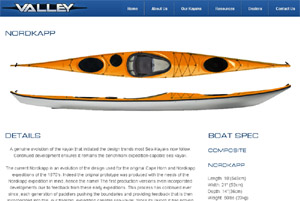
This picture from the 2010 Valley website shows
a Nordkapp Classic.
There are also some examples of the "original"
which will date from between the late '90's and the introduction
of the Classic as Valley were known to build them to special order
and a friend of mine in Glasgow certainly had one made for her.
News started to filter through on the forum in late
2014 of a development called the Nordkapp
Forti, this intended to celebrate 40 years of the Nordkapp.
Interestingly, in the information outlined in the press release
(linked from the page above), reference is made to many of the
points mentioned in this article in the context of how the boat
has evolved over the years.
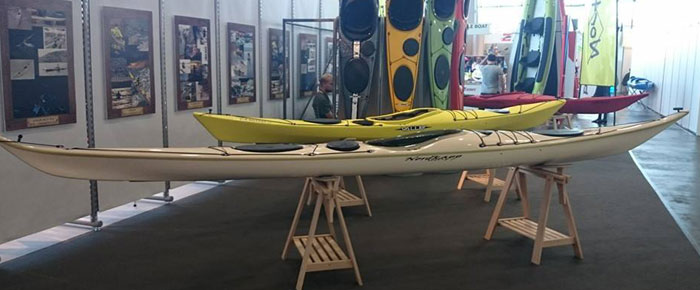
Taken from Valley's Facebook page, the 40th anniversary
Valley Forti. More pictures are
in the article. See this article
from Adventure Kayak (July 2015) for more background on the
Forti - including a picture of the team who undertook the Nordkapp
Expedition.
An interesting insight into Valley's history and
their factory setup, is outlined in this blog
post from March, 2014.
Current models
| As at January 2015 there are
4 variants all using the same name. 3 are composite, 1 is
plastic. The composites are all offered in a variety of
layups ranging from diolen to kevlar. |
| |
| •
Nordkapp is now used to designate the main design offering.
There is also a LV version, and a rotomoulded (RM) version
which sits in between the LV and the standard boat in terms
of size. The Nordkapp Forti completes the mix, and has been
designed to mirror the very first boats, but with modern
deck layout and fittings.
They come with a keyhole cockpit, oval front
and rear hatches and a round day hatch and are fitted with
a retractable skeg. Options such as a rudder, keel strip,
custom positioned front bulkhead, footpump and deck compass
can be specified as well.
The composite boats are also available as
two
or three part versions.
|
|
|
Paddlers' comments
Comments quoted here (in italics) are taken
either from Forum discussions, as referenced at the end of this
article, or from private emails received when I was researching
it.
All Nordkapps are renowned for being good boats
for those with the ability to master them. They tend to have low
primary stability and reasonably good secondary stability and
that in turn makes them a little "tippy" in the opinion
of those unused to them. It's a bit like riding a bike - fine
when moving, but a bit wobbly when stationary! That said, a sea
kayak that feels totally secure on flat water is almost certainly
going to have you in the water when it's used in bumpy conditions
so the apparent initial instability engendered by these designs
is actually a good thing. The Nordkapp probably isn't a beginner's
boat anyway.
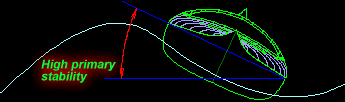
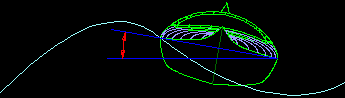
These excellent diagrams on oneoceankayaks.com's
superb
article on Choosing a Sea Kayak provide
a clear illustration of why different hull designs offer different
stability characteristics. Pics: oneoceankayaks.com
Some people find that adding some ballast
is a good idea when day paddling in a lightly loaded boat - although
the original Inuit craft probably weren't designed as load carriers
(they were primarily hunting craft), the modern incarnations are,
so that would certainly seem to be a good way of getting some
weight into the boat, so providing a little extra stability. Some
people use water carriers or bags full of sand or pebbles as a
solution. A well secured BDH
bottle full of lead also works, but whatever you use to provide
ballast, make sure it can't move - airbags have been suggested
as a way of doing this.
Nordkapps are recognized as being fast craft and
capable of handling big seas with ease, as long as the paddler
is also able to cope with big seas!
Ian Miller, by his own admission one of the "bearded
paddler" brigade and a long term Nordkapp paddler active
on the Scottish scene, provides some interesting insights into
Nordkapps - it seems there were some significant design changes
during the life of the original Nordkapps (pre the Jubilee version).
He comments as follows: " I bought my first Nordkapp,
an old HM with Henderson hatches - probably a 1976 model. At that
time in our club no one paddled them because strangely the east
coast was largely P&H territory and the west coast had the
Valleys. According to most people you needed to be a bare chested
seagull eater to handle one and I was delighted when I discovered
I actually had a fast stable boat that even improved when the
weather worsened.
I (now) have two Nordkapps, the old
HM is very stable and more to the point predictable and also very
comfortable with a legs straight out position and good knee grips.
The 'newer' HS (mid to late '90's) is an unstable pig and is unpredictable.
A factor which may be attributed to the fact that somewhere along
the way Valley altered the mould significantly adding a couple
of inches height to the deck and also added a bigger cockpit coaming
with no obvious way to control the boat". (The picture
of "Aeden's" HM shown earlier demonstrates this nicely
- many people fitted foam knee braces to give more control in
the boat and these used to be readily available from Knoydart).
Ian goes on to say "It is also significantly
less comfortable with knees forced out to the side to give any
form of control. I did recently consider a newer (early '90's)
ocean cockpit HM but it had the raised rear deck which made entry
to the cockpit a bit of a time consuming wriggle to say the least
and certainly not something I would want in a launch into a big
sea".
Such "improvements" aren't confined to
the Nordkapp of course - Ian went on comment that the P&H
Sirius had its freeboard increased early in its design life,
which also resulted in a far less stable boat in his (and other's)
opinions. The P&H Quest has also suffered by having a re-designed
(plastic) seat fitted a few years into it's evolution, this also
resulting in a noticeable loss of stability in some people's opinion.
I understand the Quest can still be built to order with the original
f/glass seat - some people have also successfully lowered the
plastic seat and report a notable improvement.
Another contributor, Phil, writing about his original
N/kapp, comments that "I also still consider it the best
rough water boat I have ever paddled".
Paddler size is a factor with these boats, as with
all kayaks. The first sea kayak I ever tried was an old original
N/kapp HM - it was way too small for me and was clearly not designed
for a 6'2" "larger" paddler as I could barely even
get into it, and even seated felt I was sitting "on"
rather than "in". Being used to modern keyhole cockpits
on river boats I found the ocean cockpit a tad claustrophobic,
but some people love them. The original ocean cockpit Nordkapps
provided paddlers with a "straight legs" paddling position
long before Rockpool re-invented the concept.
I found it incredibly twitchy but it was empty and
it needs to be remembered that these sea kayaks are designed to
carry a load, so paddling one empty is bound to feel a bit lively.
It took forever to get it to turn and I have to admit that I was
left with the impression that if this was sea kayaking, it wasn't
for me. Fortunately, I discovered there were other boats which
were both comfortable and fitted me better, but the Nordkapp certainly
whetted my interest in becoming a sea paddler.
Some years later I bought a plastic P&H Cappella
and then decided to bite the bullet and bought a brand new Nordkapp
Jubilee which was enormous fun to paddle, and somewhat bigger
and easier to get into! It felt more solid on the water than that
early HM, and was very fast. Notably faster than the Capella.
Sadly, eventually I had to admit I was really too big for it,
so sold it on. The chap who bought it absolutely loved it. Two
friends of mine who are somewhat slimmer in stature and about
6'0" both love their Jubilees.
I did find that the seat / backrest arrangement
in that boat (a
foam seat) gave very
little lower back support and I often got terrible lower back
pain when paddling it. Apparently the problem is a lack of support
to the sacral area at the base of the spine. Some people have
found Valley seats and backrests to be rather lacking in that
aspect although the latest boats seem to have a much improved
seat system.
The larger key-hole cockpits certainly made it easier
to get into the things, but of course many people worried that
the larger opening would be vulnerable to spraydeck implosion
in a big sea - those stories of imploding spraydecks on large
cockpits are probably best heard in the context of 1970's materials,
typically nylon spray decks. Modern neoprene decks will be far
less inclined to implode. The same is true of hatch covers, and
modern manufacturing methods make it possible to produce a cover/rim
combination which is far more effective than the early ones. VCP
hatches, for example, no longer require the metal tensioning band
used on the early ones.
Nick Crowhurst started a lengthy renovation of an
HM in 2006 and later wrote about the first time he used his newly
renovated boat as follows "Last Sunday morning in the
Tamar estuary the Nordkapp was in her element. There was a good
strong ebb knocking up against a SSE wind gusting to 25 knots.
The short steep chop was up to 4 feet high, and ploughing into
this was excellent. The Nordkapp just seems to get better as the
seas get rougher. I was with a friend who was paddling a long
fat poly sea kayak, and I needed to keep station with him, to
keep an eye on him and give him moral support. However, he was
traveling very slowly in the conditions.
The wind was from the port side at about 40
degrees off the bow. As I tried to travel at that slow speed,
the bow of the HM blew downwind. I corrected this by edging, lengthening
the paddle on the downwind side, and doing long sweep strokes
to keep the bow up. There was a lee shore about 40 meters away,
so I couldn't afford to drift. The Nordkapp responded by going
far too fast. I ended up by doing a series of looping runs into
and away from the wind, and it was difficult to keep close to
my friend. If I'd had a lifting skeg I could have got rid of the
lee helm, but the HM has the large fixed fin".
Writing on the forum in August 2010, Nick comments
that he's modified the boat by cutting away part of the HM stern
and adding a KariTek
wire skeg - "This morning I took the HMM out for it's
maiden voyage. I couldn't persuade the wind to blow more than
about 10-15 knots, but the modifications are certainly a great
improvement. I could paddle hard in a straight line, beam on to
the wind, stop paddling, and trim the skeg so that the kayak traveled
straight, neither weather nor lee-cocking. Bow rudders worked
much better. I didn't need the radical edge previously required,
which was just as well as I'd left my spraydeck at home........
Am I alone in such stupidity?
Of course, the bow rudder swings the bow mainly, so a better test
is the stern rudder, trying to swing the modified stern across.
These were easier than before the mods, but still not sufficiently
effective in my book, even with edging. Neither were low brace
turns, although they were better than before."
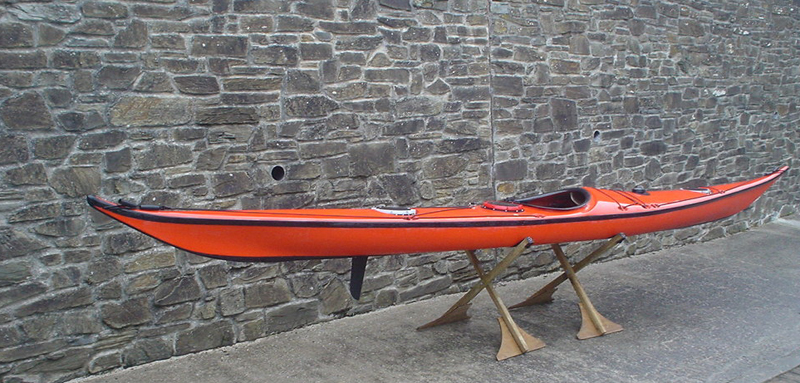
Nick removed the HM stern and fitted a KariTek
skeg - the pic here shows the first stage, he subsequently
removed a little more. The unaltered boat is shown later in the
article.
This forum
discussion contains the full story, the modifications mentioned
above being detailed in page 7. Pic: Nick Crowhurst
Leecocking (or lee helm) isn't an especially desirable
trait - what Nick is describing required him to edge away from
the oncoming waves and wind, which is inherently unstable. A leecocking
boat in an on-shore wind can be a bit of a handful. The big Aleut
Sea II does it as well if the rudder is deployed and it must have
steerage way to get the rudder to bite. I can say it's not especially
nice having experienced it. At the time, I didn't understand enough
about kayak dynamics to appreciate that the deployed rudder acted
as a giant skeg, anchoring the stern and letting the bow blow
downwind. Which is of course what happens with the inbuilt skeg
on the HM's.
Sea Kayaker magazine ran an excellent illustrated
article
on strokes and techniques to aid turning, especially in wind,
and contains good descriptions of leecocking and weathercocking.
It also describes the use of skegs, and of using bow and stern
rudders for upwind and downwind turns respectively.
Colin, another experienced Scottish paddler, also
comments on the tendency for the HM to leecock and wrote "The
people I paddle with all have old Nordkapps. My wife's old boat
had a rudder, built early 1980's, as were the two other HM boats.
This was a boat you loved or hated, a gent called Bill Reoch who
was paddling expeds till he was 69 owned one, I remember having
to push the stern round because it just was not for turning, in
a big sea, off Toe Head. I think the boat I disliked the least
was the one with the rudder, so I suppose that I am in the hate
camp.
They are still fast boats, and if you are the
only one in the group without one, you are always at the back.
The others I paddle with swear by them, me, just at them".
Duncan
Winning commented on the large fixed skeg on the HM's and
told me that "Gordon
Brown (of Skyak) cut his back, a bit at a time, 'till he got
the hull balanced to suit him."
Of the later versions, Charles Scott writes about
his new poly Nordkapp and says "seems just as fast as
the "proper" Nordkapp and handles the same. I think
it's very slightly more stable than the Jubilee, but this might
be because I've been paddling it every Wednesday night and I'm
comfortable with it. The level of finish is good, the bulkheads
are neatly sealed and the seat is comfortable and well fitting.
The footrests use a decent aluminium rail system, although the
thigh grips aren't in a great place, but I get a comfortable knee
grip on the inside of the coaming.
Decklines are good, if slightly mimimalistic,
especially on the back deck where I have a couple more elastics
on my Jubilee.
Do I have a gripe about it? Yes - but it's a
small one. The cockpit is too long. Now I'm only 5' 7'' but there
is fully 18" in front of the footrests from my feet to the
front bulkhead. So if you are a 7' 1" paddler with the same
body length as me then this is good, but one of my paddling partners
is 6' 2" and he has 14" between the bulkhead and his
feet. Maybe this is a fabrication necessity, but this is bad as
it's not usable space, unless you fit some kind of false bulkhead
or cargo net and you're still going to take on more water than
you'd like in the event of a wet exit".
Interestingly, finding comments about Jubilees from
paddlers on the Forum is actually quite difficult and one is left
to wonder how many are actually out there, certainly in comparison
to the old HS and HMs. The "Enthusiast" or RM boat is
clearly well thought of.
Simon Willis, writing on his blog
in 2007, reviewing the Nordkapp, says good things about the
Nordkapps he and his wife Liz have - Gordon Brown warned him that
"It will force you to do things the right way".
"It's a boat which automatically punishes sloppy paddling.
An on-board coach. With a stick!" But he also says that
his wife Liz got it in one. "If you choose something
else, you'd always wonder if you should have had a Nordkapp".
It wouldn't work the other way around."
The LV Nordkapp is getting good press - wilcoj2
on the forum writes that "the Nordlow is very impressive
when pushing through surf, winds and waves. It is also amazingly
neutral in beam winds and seas. A problem I have had is that no
one can keep up with me if we are pushing through seas and/or
wind. One friend who I usually have to struggle to pace, noted
that she cannot keep up with me when I'm in my 'kapp LV. As the
Nordlow gains so much stability as it moves faster in conditions,
I have to consciously slow to not out run fellow paddlers. It
also runs downwind very very well."
From the States, Scott Lovrien comments on the first
outing in his lovely new Nordkapp Classic that he "loved
her from the first paddle stroke to the last. She is a tiny bit
tender – but should feel more at home with her with about 10 hours
in the seat. Noticed she likes to sit on one chine or the other
too – much like a Nigel Foster Legend or Silhouette boat too.
Must be those narrow ends and the generous V hull – but like I
said – loved it all just the same". He also noted though
that it came without a compass recess, despite the image in Valley's
material showing it with one.
In July 2014, "gasserra" made this comment
in the context of comparing the modern and "original"
boats - "it's surprising how often it comes up, but it
seems that relatively few have paddled both the older versions
and the current version a lot. I've owned a 20 year old Nordkapp
HM for going on 16 years and the newest version for about 2. Above
waterline they look similar, but they handle and feel very differently.
The hull shapes are quite different, including more rocker in
the newer model - which seems to play a big role in its improved
stability and maneuverability. And the lower coaming on the cockpit
aft makes rolling easier. But the old one is still just faster.
Same name, different boats."
At around the same time, M-J-B made this comment
comparing the RM and the fiberglass LV boats - "The size
is different, the fit is different and the handling is different,
i.e. two totally different boats. The seat in the LV is quite
easy to lower if the fit is too tight, but the thigh braces in
the RM feel quite different from the LV regardless of their position."
The Nordkapp in its latest incarnation seems to
be popular in Australia - writing on the
Expedition Kayaks blog in July 2014, Rob Mercer noted "-
- of the seven boats already on the beach all were Valley Nordkapps
or Nordkapp LVs. On easier weeks some would have been in faster
boats for a workout or more manoeuvrable boats to play but in
the more challenging conditions of steep seas over rebounding
swells these seven experienced paddlers had defaulted to their
Nordkapps; a serious boat for serious conditions."
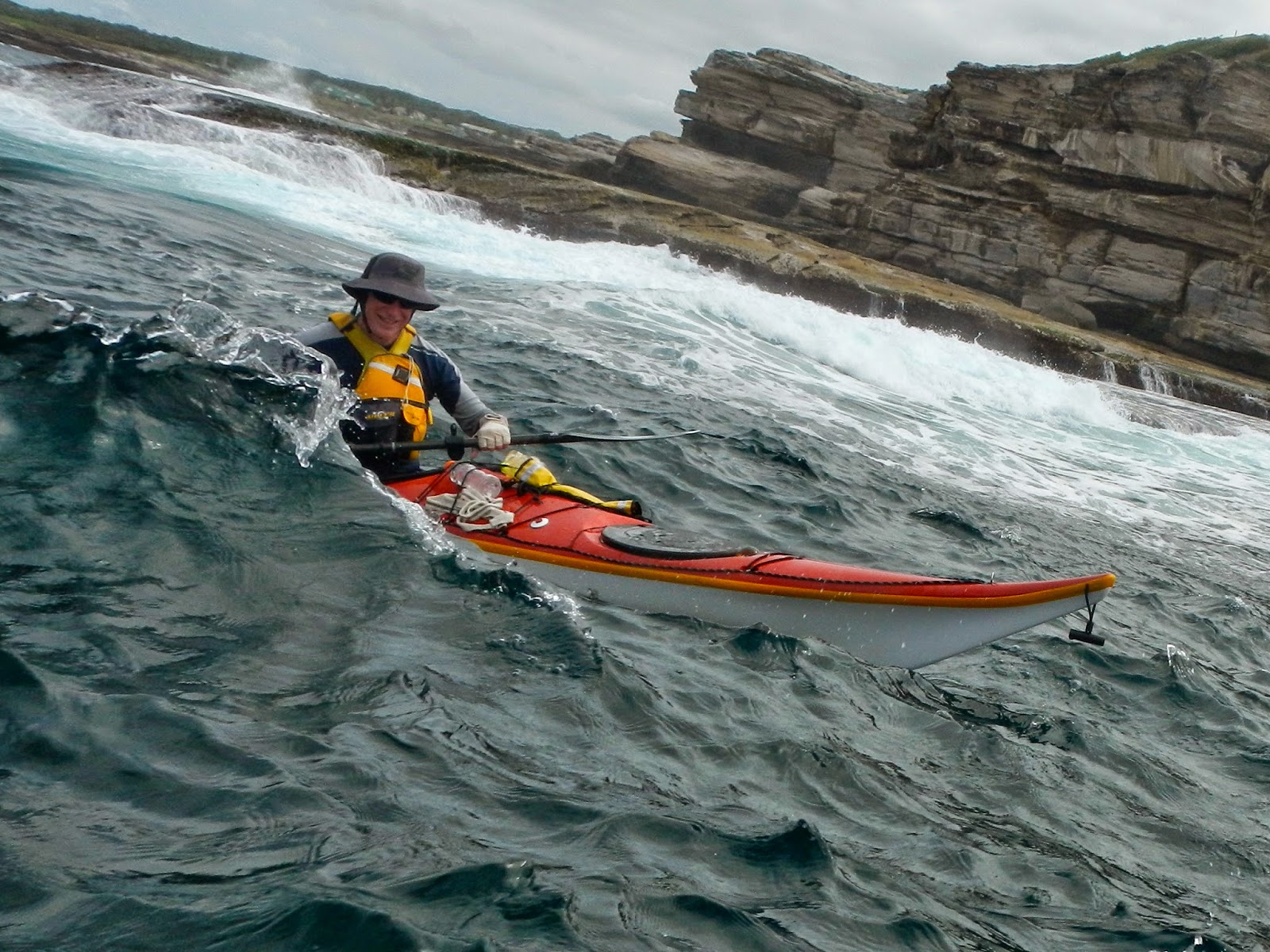
From the EK blog, a Nordkapp doing it's thing.
They are undoubtedly probably amongst the nicest
looking kayaks on the market today and the original versions just
look "right" as well. There must be hundreds of original
Nordkapps afloat (or not - one has lain undisturbed on Easdale
for years) - is that because they are superb craft? Or because
they were one of the few decent sea kayaks available in the 1970's?
Or because people bought a boat because of it's reputation? Or
just because they were the nicest looking?
The original versions will still command premium
prices on the second hand market. A friend of mine bought an HS
as her first ever sea boat - she never really enjoyed paddling
it though. She paid less than £100 and sold it for well
over £500 a year or so later, which is astonishing. She
replaced it with a poly Mk2 Cappella and reports that she is far
happier in it than she ever was in the HS. She is a relatively
tall person, so that could have a bearing of course.
Ian Miller provided an interesting thought when
he told me that he remembered Jim Weir (another well known Scottish
paddler) pointing out that Valley had been continually changing
the (original) Nordkapp plug over the years and that some dimensions
such as the rear deck height had risen considerably. He thinks
this is why there are so many differing views on what is apparently
the same boat and certainly my experience (and his) seems to confirm
this. The comments from Valley regarding the development of the
new Forti in late 2014 also confirm this.
Judging by the number of pictures of old Nordkapps
in really excellent condition, it does seem that a lot of these
boats didn't get that much use. One wonders how many people bought
one because of its reputation, and then discovered they just didn't
have the skills to handle it? Or, if it was an HM, they couldn't
get it to turn?
Then again, some of them have clearly been put to
very good use indeed - as evidenced by the Nordkapp and Cape Horn
Expeditions and Paul Caffyn's journeys, not to mention varius
others.
As I said at the start - you need to know which
version you are talking about - a Nordkapp Jubilee just isn't
the same as an "original" Nordkapp, and even those vary
enormously. Since its inception the Jubilee has been modified
significantly as well, and of course Valley validated this when
designing the Forti in 2014. It's also relevant to know whether
the boat is UK or US spec. There don't seem to have been any US
spec boats sold in the UK or Europe - unless you know different
- - -
For those people with the skills to paddle them
well, and who are of the right size and build to fit in them,
they are clearly regarded as being superb, fast and seaworthy
craft. Liz Willis' comment sums them up: "If you choose
something else, you'd always wonder if you should have had a Nordkapp".
And on that note, Scott Lovrien, who is pictured later in this
article in his Classic, wrote to me in Feb 2015 to say he's just
ordered one of the first of the four Nordkapp Fortis currently
making their way to the States. He comments "More than
a few of my paddling club brethren have given me grief about going
through so many (great) boats, but you know, in the end I always
come back to the quote from your website from that gal who says
something along the line of "..always wonder if you should
have gotten a Nordkapp."
Anyway, I thought you might get a charge from the fact that despite
owning about 25 different kayaks over the last 10 years (yeah,
2.5 per season) I will end up coming home to the Nordy. I can't
wait to get out in her…hope the wife doesn't mind moving over
so the Nordy can sleep on the bed…"
Pictures
Unless otherwise noted, these are UK or European
specification boats. This Google
search will find you several thousand images under "Nordkapp
+kayak".
|
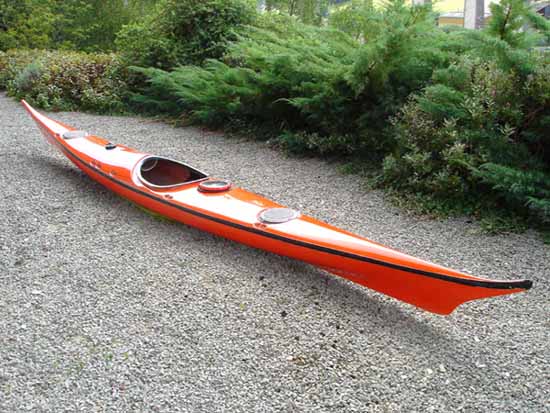
Nick Crowhurst's nicely
renovated HM (age unknown) - the pic clearly shows the
extended keel added to the original design, so differentiating
it from the HS. Nick has subsequently cut away part of
the HM stern and added a KariTek wire skeg.
Spec: round front and rear Henderson hatches, ocean c/pit.
The day hatch on this one replaced the oft-fitted (and
relatively useless) "Chimp
type" rear-deck mounted pumps. There is a "knee
tube" just visible in the c/pit, these being popular
as a place to store odds and ends or a flask. Pic: Nick
Crowhurst |
|
| |
Ido van der Meer's superb early Nordkapp
HS. Age unknown. The rear deck appears lower and flatter
on this one than in "Aeden's" one shown below.
Spec: 2 round hatches - the boat is fitted with an early
skeg design, described in this
blog entry from the States. Pic: Ido van der Meer
|
| |
| |
"Aeden's" superb 1985 or 1988 Nordkapp HM
Spec: 2 round hatches, ocean c/pit, extended (HM) keel.
Note the knee braces in the cockpit. Pic: "aeden"
|
| |
|
| Mair in an "original"
Nordkapp HM - this one thought to be built about 1986
or 1988. Picture taken in the Dorus Mor, with the Corryvreckan
in the background.
Spec: Two small round hatches, ocean c/pit, extended (HM)
keel. Pic: Douglas Wilcox |
| |
| |
"Spinning Plates" posted
this pic of his HM - it clearly shows the round VCP hatches,
ocean c/pit and a Chimp pump mounted on the port side.
Just visible above the gray stirrup pump sitting on the
front deck is the recess for a deck compass (probably
the Silva58 or a Sestrel
- thanks to John Ozard for the details). This boat also
seems to have the mounting bracket for a removable Silva
70UN or possibly a Silva73R. The early type integral recessed
deck fittings are clearly visible.
This boat has the "Cape Horn" layout which echoes
the deck layout used on the Cape Horn expedition.
|
| |
| |
Sandy Donald acquired this HM in 2014
and believes it may date from around 1993-5. Note the
central day hatch which he finds most unusual and wonders
if it was one of the earliest examples of this feature.
The oval rear hatch is also interesting. It has a bar
footrest which also suggests an older model. Note also
the Henderson deck-mounted pump, with the moulded recess
for the handle on the starboard side of the deck. Pic:
Sandy Donald
|
|
|
A brace of "original" Nordkapps - The one
on the left is Kevin Mansell's 1985 HM; on the right
is an early to mid 1990's HS owned by Chris Jones, with
a retractable skeg (this being just visible) and the
later screw-in recessed deck fittings. It also has a
moulded recess to take a Compac 50 pump and the compass
recess is also different, being filled with a Silva
70P. This picture also nicely illustrates the lines
of these boats - very pretty. Click the image for the
(much larger) original image.
Pic: "Captain Sensible" / Matt Pope
|
| |
|
Tim Dawson's late 1990's kevlar Nordkapp
Jubilee on Loch
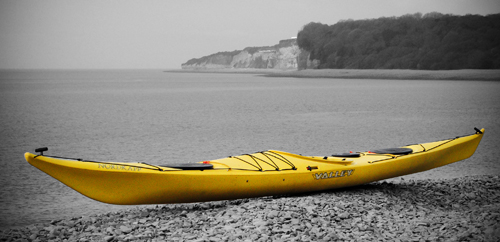
Teacuis in 2006. (It was a very wet weekend!). This
particular boat had been previously owned by Dave Felton
of Knoydart.
Spec: Round front hatch, oval rear hatch, round day hatch,
keyhole c/pit, skeg.
Note the subtle difference in the shape of the upsweep
in the stern compared to the photo of the yellow 2004
version below.
Pic: Mike Buckley. |
|
| |
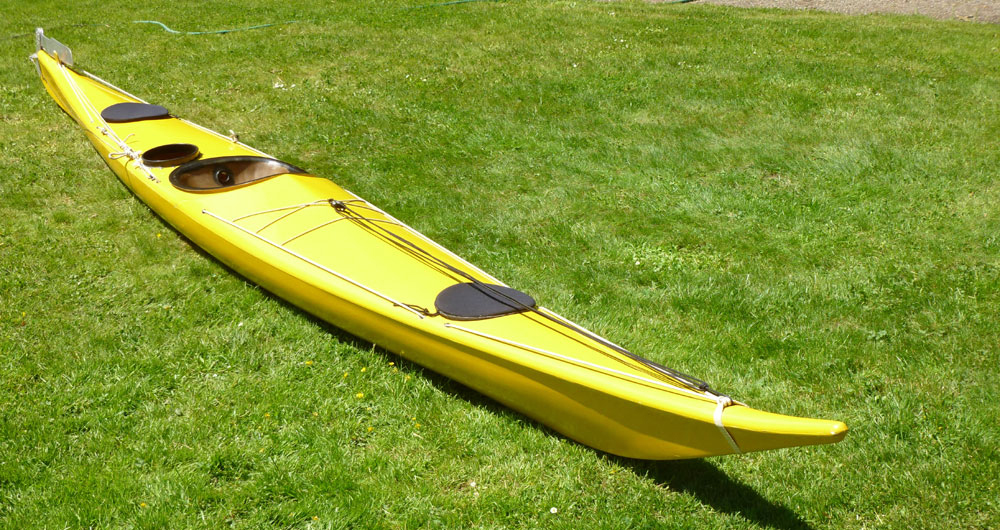
Two pictures of Mair's 2004 Nordkapp.
Spec: Two oval hatches, round day hatch, keyhole c/pit,
skeg. Compass recess now situated for'ard of the front
hatch. Pics: Douglas Wilcox. |
|
|
2006 Nordkapp LV.
Spec: Two oval hatches, round day hatch, keyhole c/pit,
skeg. Note the considerable rocker. Pic: Douglas Wilcox |
| |
|
"Tiff's" December 2006 Nordkapp Jubilee
Spec: Two oval hatches, round day hatch, keyhole c/pit,
skeg. Pic: "Tiff".
|
| |
|
By way of comparison,
this shot of "Tiff's" Jubilee beside an early
P&H Orion shows how narrow the Jubilee is at 21 ins
compared to the Orion's 24ins. The much bigger oval hatches
make packing considerably easier. Pic: "Tiff". |
|
|
Scott Lovrien, from the
States, in his gorgeous 2010 Nordkapp Classic. This taken
on it's very first outing on 2 May 2010 in the “ Thimble
Islands” area, Connecticut . He commented that he
is delighted with it, but notes that despite the Valley
promotional picture showing it with a compass recess,
it doesn't have one.
Spec: Oval rear hatch, round day hatch, round front hatch,
ocean c/pit, skeg. Pic: Scott Lovrien |
|
|
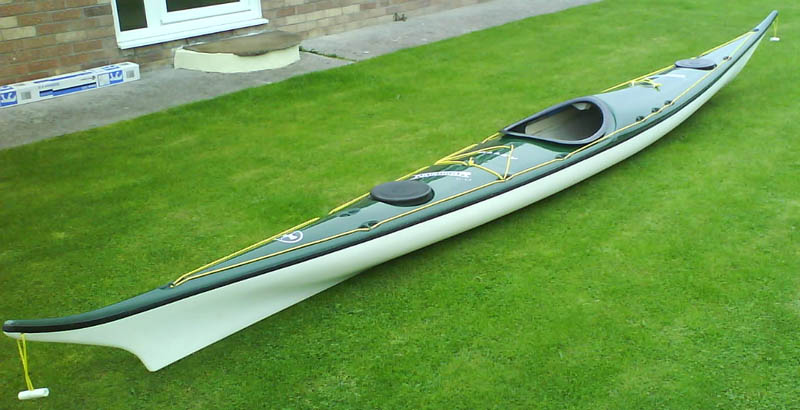
"taran tyla's"
Nordkapp RM |
|
| |
|
| |
John Ravenscroft from
Ottawa, Canada, found this Nordkapp offered for sale on
MEC's Online Gear Swap - believed to be 1995. It appears
to be fitted with the same rudder design as the NZ boats
mentioned by Paul Caffyn. Perhaps it's a Sissons made
boat? |
| |
| |
|
| |
|
Chris McDaid posted this
picture on Facebook in Feb 2015. The boat is an HM, probably
an early one. What is interesting is the rather unique
way the hatch covers are fitted. He notes that they are
neoprene covers with a secondary white hard plastic cover
secured by straps glassed in under the deck. In the same
discussion, Howard Jeffs comments that "the hatches
are obviously post manufacture as are the deck fittings."
This based on the fact that the deck fittings appear
to be an aluminium bar in the recess, rather than as described
earlier in this article. |
|
Nordkapp Timelines
This summary
gives an overview of notable developments / changes to the Nordkapp
and it's variants, as well as significant expeditions the boat
has been used on. Please contact
me if you can add to it.
Relevant UKSKGB Discussions
Various versions of the Nordkapp are mentioned in
this discussion
and also here.
See this discussion
for comparison between the Jubilee and a NDK Romany Explorer.
This discussion
has a detailed write up by Jim Wallis of his impressions of paddling
an HM, and some history of the boats, as well as some interesting
comments by experienced N/kapp paddlers.
This discussion
also has some Nordkapp history.
This discussion
has pics and first impressions by Douglas Wilcox and others of
the Nordkapp LV.
This discussion
mentions the Nordkapp LV and includes pictures of one under sail.
This discussion
includes a very detailed comparison of the Nordkapp LV and the
Tiderace Excite.
This discussion
references the RM / poly "Enthusiast" version, as does this
one.
This discussion
started by Nick Crowhurst is about renovating an original Nordkapp,
but also has a wide range of discussion ranging from paddling
technique to HM / Jubilee comparisons. Nick describes the joys
of trying to turn an HM rather well.
This discussion
provides some insights into how the Nordkapp is regarded today
in comparison to other boats like SKUK and Tiderace designs.
This discussion
on the Pintail includes some links to discussion elsewhere with
background into Nordkapp development. Thanks to Jim Wilson / "wilsoj2"
for some useful background from the US perspective.
This discussion
references the US spec H20 HM and also the (original) HMC model.
This discussion
considers the Jubillee, but also includes comparisons with the
original design and provides some comment comparing the RM and
LV varients as well.
This discussion
references the Nordkapp Forti.
Other references
Valley
Sea Kayaks website.
Technical comparison data can be found in the DKV
Buyers Directory
From Sea Kayaker (US) magazine - tech specs for
the Nordkapp
LV and H2O
From Paddling.net - reviews
of (US) Valley boats
The Paddling.net
forums also have numerous references to Nordkapps - remember
this is generally from the US perspective.
Although a bit out of date now (1998) this article
on choosing a sea kayak by Altlantic Kayak Tours is worth
a look and mentions the Nordkapp and other Valley boats.
From Adventure Kayak (US) - review
of the Nordkapp RM.
From Simon Willis' blog - his
impressions of Nordkapps.
Douglas
Wilcox's review of the Nordkapp LV on his blog. He also references
the RM version.
Greenland
Kayaks - a .pdf with some history of Greenland Kayaks.
Sue
Ellcome's Greenland Kayak is worth looking at to get an idea
of how these craft were originally constructed.
How a fiberglass boat is built - interesting article
from Kayarchy.co.uk on how these boats are built.
The
Nordkapp page of the 1985 Valley brochure.
The
1988 Valley brochure (now in colour). Thanks to Arnold Kuiter
for this and also the excerpt from the 1985 catalogue.
The
2005 Valley / GRO catalogue. Thanks to Jim Wilson / wilcoj2.
Duncan Winning kindly provided an article on the
history
of the Greenland kayak, incorporating the "family tree"
of some 43 different craft. There is also a very detailed history
of the Greenland Kayak's importance to UK sea kayaking entitled
"It's Inuit int.it?". In July of 2004 Duncan went to
Greenland on a four-week project titled “The
Inuit Origins of Modern Recreational Sea Kayaks”.
National Maritime Museum in Cornwall.
Glasgow
Museums Resource Centre.
Thanks are due to Darren Bush of Rutabaga in Madison,
Wisconsin for the pictures of the 1975
Expedition boat, and to Brian Day of Pyranha US Sales and
Marketing for the lead.
PDF
of the August / September 2008 issue of KASK - contains details
of Paul Caffyn's 2008 trip in a Sisson Kayaks Nordkapp.
Further reading on the Greenland Kayak, notably
the differences between East and West Greenland types can be found
in the article by Sandy Noyes, page 54. in the
Summer 2011 issue of Masik. It also contains an article on
the various other types of kayaks used by native peoples, itself
interesting in that the rationale between hunting craft and boats
designed for travel is clearly evident. The
Summer 2013 issue of Masik contains a fascinating and in-depth
article on "Deconstructing Greenland Kayaks" which describes
the background to how these boats were built.
From the
Australian Expedition Kayaks blog, Rob Mercer's comments on
his experience of paddling a Nordkapp over the last five years.
There are some wonderful images of a replica of
the Taylor boat here.
Bibliography / Web references
BCU (1991) - Canoeing Handbook - The Tickle
Group
Brown, G (2007) - Sea Kayak - Pesda Press
Caffyn, Paul (1999) - The
Long Journey Home for a Greenland Kayak - from KASC website,
accessed 13 May 2011
"Haris" - Vintage
Valley Nordkapp HS Review - Paddle'N'Hull blog, accessed 24
May 2012
Hutchinson, D (1997) - The Complete Book of
Sea Kayaking - A&C Black Ltd
Ridgeway, R (1993) - Something Amazing
- Hodder & Stoughton
Taylor, K (2011) - The
Hunting Trip To Umiamako - Kayakgreenland 1959 blog,
accessed 8 November 2011
Taylor, K (2013) - Chapter
Twelve: Re-encounters with the Kayak - Kayakgreenland
1959 blog, accessed 8 March 2016
Expedition Reports
The 1975
Nordkapp Expedition Report - thanks to Clive Merrifield for
sending me scans of a copy of the report found in a pile of second
hand books - also thanks to Nigel Matthews, Paul Caffyn and Allan
Cadenhead who also very kindly offered to get copies to me. Thanks
to Paul Caffyn for the KASK
magazine from 1999 which contains a summary overview of the
Expedition.
The 1977
Cape Horn Expedition Report - thanks to Nigel Matthews who
sent me a pristine hard-copy of the trip report, and to Jim Wallis
for fettling the PDF into proper page order for me.
I'd been looking for these reports ever since I
originally wrote the article, so when they eventually surfaced
in late 2012 it was great to be able to put them up on-line for
what might well have been the first time!
In March 2016, these documents were passed into
the care of Glasgow
Museums Resource Centre to be held with the other material
related to the Ken Taylor /Illorsuit (Igdlorssuit) kayak they
have in their reserve collection. My thanks to Patricia Allan,
Curator of World Cultures at Glasgow Museums for her interest
in this material.
Thanks to all those named in the article for input,
comment, advice and pictures. The article has been "peer
reviewed". Valley were naturally asked to review, input and
comment but didn't respond. They have however been known to be
very helpful in responding to telephone enquiry regarding specific
queries.
As new or additional material and information comes
to light, the article is updated to reflect that. While it would
of course be nice to be able to maintain a log of such changes,
or retain previous versions of the article, the practical reality
is that doesn't happen. Some of the content can be, and has been,
validated - some of it however is the result of people's recollections,
so things like dates when changes or notable developments took
place are inevitably less precise than they would ideally be.
You are welcome to link to or reference this article,
or indeed use the various attachments and links for non-commerical
purposes. I'd welcome an acknowledgment of the source and you
should also think about copyright and such like with other people's
work. Again, I'm sure an acknowledgement would be appreciated.
Can you add more to this article?
Please contact
me if you have any useful information, more background (especially
relevant dates and Velley's serial numbering systems) or interesting
pictures. Please also tell me if you spot any errors, inaccuracies
or broken links.
© Mike Buckley - article originally
written March 2008 - last updated
08-Mar-2016
.
|